
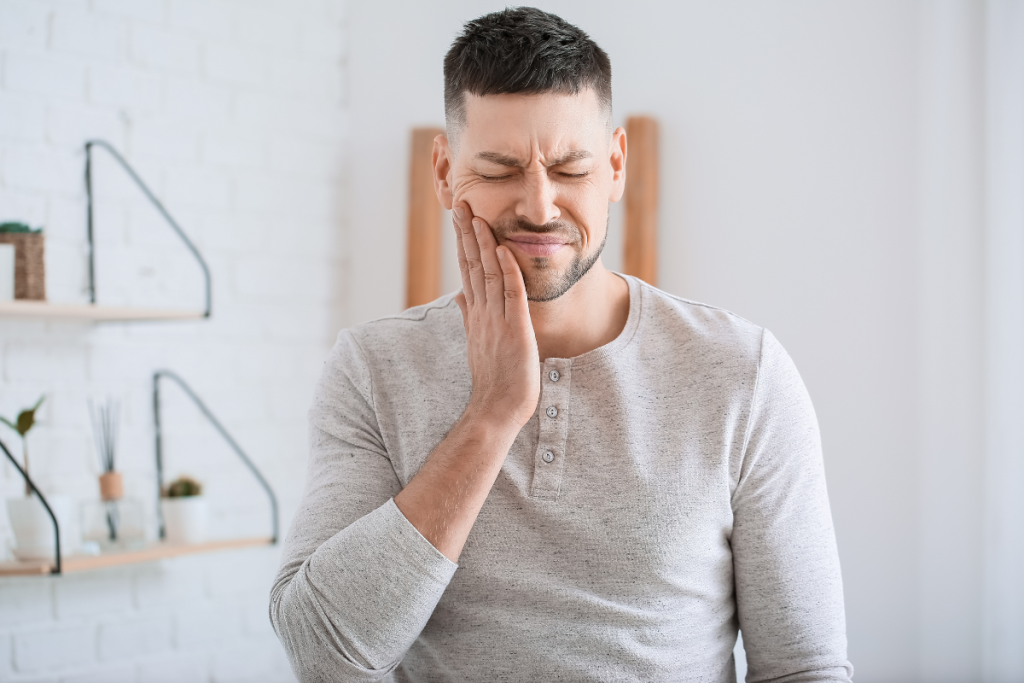
Most serious tooth problems start without pain. By the time a tooth aches, the damage is often deep. Watch for sensitivity, bleeding gums, bad breath that won’t go away, a small dark spot, or a bite that feels off. Any of these is a good reason to book an exam.
Why a Tooth Can Feel Fine, Then Hurt Overnight
You wake up with a throbbing tooth. It felt normal yesterday. What changed?
Usually, nothing changed overnight. The problem was growing for months. A tooth has three layers. The hard outer layer is enamel. Under it sits softer dentin. At the center is the pulp, where the nerve lives.
Enamel has no feeling. Decay can eat through it and into the dentin with no pain at all. Pain often starts only when germs reach the nerve. At that point the fix is bigger, and so is the bill.
The same is true for gum disease. It is often painless in the early stages, yet it is a leading cause of tooth loss in adults, according to the Centers for Disease Control and Prevention (CDC).
Early Signs You Should Not Ignore
Your mouth gives small hints before the big pain. Look for these:
- Sensitivity to hot, cold, or sweet foods. It may be a cavity or worn enamel.
- Gums that bleed when you brush or floss. Healthy gums do not bleed.
- Bad breath or a bad taste that stays. Brushing does not fix it when the cause is decay or infection.
- A dark spot or small pit on a tooth. Many cavities start as tiny marks.
- Pain when you bite down. This can point to a crack or a failing filling.
- Red, puffy, or receding gums. Teeth may look longer than before.
- A loose tooth or a change in your bite. Do not wait on this one.
- A pimple-like bump on the gum. It can mean an infection under the tooth.
- Jaw soreness or headaches in the morning. Night grinding is a common cause.
Try This 60-Second Check
Answer yes or no to each question.
- Do your gums bleed at least once a week?
- Does cold water or ice cream make a tooth zing?
- Has it been more than 12 months since your last dental exam?
- Do you wake up with a sore jaw or a dull headache?
- Have you seen a spot, chip, or crack on a tooth?
- Do you have a filling or crown that is more than 10 years old?
Your result:
- 0 to 1 yes: Keep up your routine and stay on a regular visit schedule.
- 2 to 3 yes: Book a visit in the next few weeks.
- 4 or more yes: Schedule an exam soon. Early care costs less and hurts less.
This check is not a diagnosis. Only an exam and X-rays can show what is going on.
Warning Signs at a Glance
| What you notice | What it may mean | How soon to call |
| Quick zing with cold or sweets | Early cavity or worn enamel | Within a few weeks |
| Bleeding gums | Early gum disease | Within a few weeks |
| Pain when biting | Crack or failing filling | Within a few days |
| Lingering ache after hot or cold | Decay near the nerve | Within a few days |
| Bump on the gum | Possible infection | Same day or next day |
| Swelling in the face or jaw | Spreading infection | Same day, urgent |
| Loose adult tooth | Advanced gum disease or injury | Same day or next day |
Facial swelling with fever, or trouble swallowing or breathing, needs the emergency room right away.
What Happens at a Dental Exam
Many patients put off a visit because they fear bad news. Knowing the steps helps.
During a routine visit with a dentist in Niceville, the team checks each tooth for decay, cracks, and worn spots. They measure the gum pockets around every tooth, since deeper pockets can signal gum disease. They also check your tongue, cheeks, and throat for early signs of oral cancer. X-rays show what the eye cannot see, such as decay between teeth, bone loss, and trouble under old fillings.
You get a clear explanation of what was found, what can wait, and what cannot. You also get a cost estimate before any treatment starts. If something looks fine today but needs watching, the team tells you and sets a plan.
Everyday Habits That Hide Problems
Life on the Emerald Coast has its own dental risks. Beach days mean sports drinks, sweet tea, and sipping soda for hours. Constant sipping keeps acid on your teeth all day. Water is a better choice between meals.
Stress is another factor. Many adults clench or grind at night without knowing it. Over time it wears enamel, cracks teeth, and strains the jaw. A mouth guard can help, and so can a check for airway or sleep issues when the signs point that way.
Military families near Eglin Air Force Base move often. Moves can break a care routine, and a missed year can hide a cavity. If your records are scattered, a fresh exam and new X-rays give you a clear starting point.
Meet Our Dentists
Patients often ask who will treat them. Here is a short look at the doctors at Mid Bay Dental.
Dr. Justine Chase, DDS
Dr. Chase opened Mid Bay Dental in 2001. She earned her dental degree from the University of Iowa College of Dentistry in 1997 after studying biology at the University of North Carolina at Chapel Hill. She has trained for years at the Pankey Institute and the Spear Institute, where she is a faculty club member. Her training also covers orofacial myofunctional therapy and tongue tie care. She is a member of the American Dental Association and the Florida Dental Association. This depth matters when symptoms are hard to explain, such as jaw pain, mouth breathing, or poor sleep.
Dr. Kathleen Hood, DDS
Dr. Hood earned both her undergraduate and dental degrees at the University of North Carolina at Chapel Hill. She then completed an Advanced Education in General Dentistry residency at the Medical University of South Carolina, with added training in hospital dentistry and care for patients with special needs. She has worked in dentistry since 2008 and is nitrous oxide certified, which helps nervous patients stay calm. She is also an Invisalign Gold level provider. As a military spouse, she knows what it is like to start over in a new town.
Dr. Bianca Gardner, DDS
Dr. Gardner earned her dental degree at the University of Kentucky College of Dentistry in 2020 on an Army scholarship. She served on active duty as a general dentist, including a residency at Joint Base Lewis-McChord and service at Joint Base San Antonio-Fort Sam Houston. She left active duty in October 2025 and joined the practice so she could keep caring for veterans and their families. Her interests include esthetic dentistry and sleep dentistry, which fit well with spotting grinding and bite problems early.
What to Do if Pain Starts Suddenly
- Rinse your mouth with warm water.
- Gently floss to clear any trapped food.
- Use a cold pack on the outside of your cheek for 15 minutes at a time.
- Take an over-the-counter pain reliever as the label directs, if it is safe for you.
- Do not place aspirin on the gum. It can burn the tissue.
- Call the office as soon as it opens and describe your symptoms.
If you know you need urgent care, an emergency dental visit in Niceville should not wait for the pain to “settle down.” Pain that fades can mean the nerve has died, and the infection can still spread.
Simple Habits That Protect Your Teeth
The American Dental Association (ADA) gives these basics:
- Brush twice a day for two minutes with fluoride toothpaste.
- Clean between your teeth once a day.
- Limit sugary and acidic drinks.
- Replace your toothbrush every three to four months.
- See your dentist for exams on a regular schedule.
The ADA also notes that most people do well with a visit once or twice a year, though some need more. Your dentist can set the right schedule for you.
Know Your Next Step
A quiet tooth is not always a healthy tooth. If you noticed even one sign in this article, act on it now. A small filling today can save you from a root canal or an extraction later.
If you want a family dentist in Niceville who will explain each finding in plain words, Mid Bay Dental offers dental wellness exams at 4579 Hwy 20 E, Unit 210, Niceville, FL 32578. Office hours are Monday to Thursday, 7:30 am to 4:00 pm. Request an appointment online with Mid Bay Dental, look at the full list of services, or find the office on Google Maps.
Don’t wait for the morning when the pain starts. Book your exam today.
Frequently Asked Questions
1. Can a tooth have a cavity and not hurt?
Yes. Enamel has no nerves, so decay can grow for months with no pain. Pain often shows up only after decay reaches the nerve.
2. Why does my tooth hurt more at night?
When you lie down, more blood flows to your head. This adds pressure inside an inflamed tooth. Less distraction at night also makes pain easier to notice.
3. Is tooth sensitivity always a sign of a cavity?
No. Worn enamel, gum recession, grinding, and whitening products can also cause it. An exam shows the real cause.
4. How often should I get a dental exam?
Most adults do well with an exam and cleaning once or twice a year. People with gum disease, dry mouth, or many fillings may need more visits.
5. Are bleeding gums normal?
No. Bleeding is a common first sign of gum disease. It often stops once plaque is removed and good cleaning habits start.
6. Do dental X-rays have risks?
Modern dental X-rays use very low radiation. They help find problems that cannot be seen, and your dentist uses them only when needed.
7. What should I do about a chipped or cracked tooth?
Rinse with warm water, save any broken piece, and call your dental office. Cracks can grow, so do not wait for pain.
8. Can stress affect my teeth?
Yes. Stress often leads to clenching and grinding. Over time this wears enamel, cracks teeth, and causes jaw pain and headaches.